
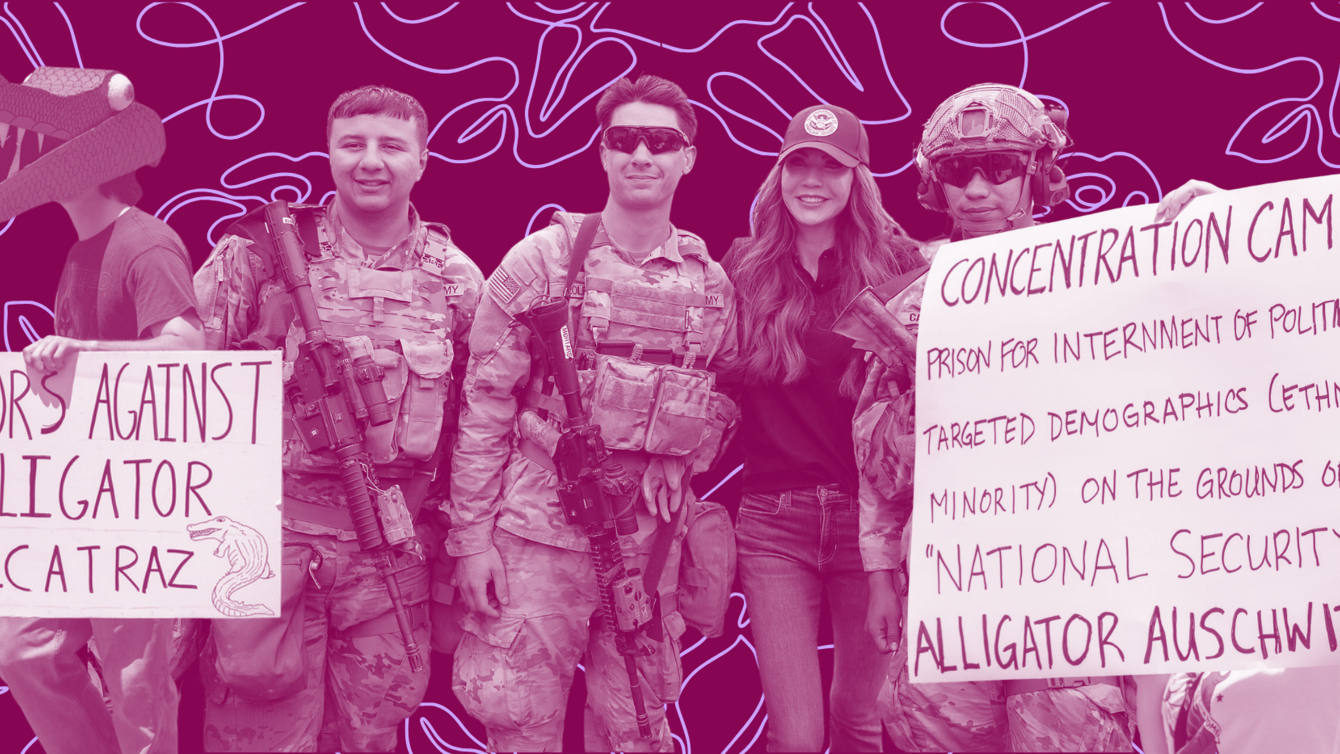

In July of this year, Florida Governor Ron DeSantis and his Attorney General James Uthmeier announced the opening of the detention facility they officially named “Alligator Alcatraz,”[Footnote 1] a nod to Donald Trump’s fascination with re-opening the original Alcatraz prison in San Francisco. The prison was constructed hastily, so much so that people are living in soft-sided structures not intended for long-term habitation. Wholly built and paid for by the state of Florida, the facility is the subject of multiple lawsuits for its environmental disruption and its incursion on Indigenous lands.[Footnote 2] DeSantis bragged that the prison was adjacent to a runway, part of a decommissioned airfield that he took over via executive order[Footnote 3] ; he envisioned a dystopia where the facility served as a “one-stop shop.”[Footnote 4]
“Alligator Alcatraz” emerged from a concerted effort by DeSantis’s administration to not just assist but lead the Trump administration’s mass deportation scheme. A few months before the prison opened, Florida law enforcement agencies cooperated with ICE and DHS in “Operation Tidal Wave,” a “first-of-its kind partnership between federal and state law enforcement organizations” that resulted in approximately 1,120 people disappeared into the deportation machine.[Footnote 5]
The cooperative component of Tidal Wave resonated with GOP Florida politicians at every level. “I’ve insisted that Florida be the tip of the spear when it comes to state support of federal immigration enforcement,” Florida Governor Ron DeSantis said. Larry Keefe, Florida’s “Public Safety Czar” who leads Florida’s Board of Immigration Enforcement and was best-known for orchestrating flights of immigrants from Florida to Martha’s Vineyard in 2022, [Footnote 6]emphasized that Tidal Wave was a “blueprint,” a “warm up” and a “test run” for a “persistent, permanent pressure.”[Footnote 7] “Lots of logistics, complexities that would make Amazon delivery or Federal Express blush,” he bragged in a May 1 press conference,[Footnote 8] echoing Acting ICE Director Todd Lyons’ comment at the Border Security Expo in April that he hoped mass deportation would be as efficient as “Amazon trying to get your Prime delivery within 24 hours.”[Footnote 9] Building on such efforts, Trump’s FEMA has allocated $608 million for a “detention support grant program” designed to assist other states that hope to emulate Florida.[Footnote 10]
Neither Operation Tidal Wave nor the construction of the Everglades prison could exist without 287(g), a federal immigration enforcement program included as a provision in the Immigration and Nationality Act. 287(g) agreements, described as a “force multiplier” in the lingo of deportation bureaucracy,[Footnote 11] allow local law enforcement to act as de facto ICE agents with minimal training.[Footnote 12]
“Florida has interpreted—and the federal government has allowed—287(g) as providing unlimited permission for states to implement ‘mass deportation’ as viciously and violently as they please.”
Historically, ICE’s 287(g) agreements have relied on two frameworks to advance an “attrition through enforcement” strategy that expands the deportation machine.[Footnote 13] The “Jail Enforcement Model” deputizes law enforcement to act as immigration agents who assess immigration status and cooperate with ICE to send people from the jail to ICE detention. The “Warrant Service Officer” program, added in May 2019, allows state and local officers to serve administrative warrants, thereby arresting people for ICE and turning them over. Both approaches streamlined the process of deporting people who land in county jails, most of which are run by county sheriffs. The logic relied on an assumption that people in county jails were likely guilty of criminal activity. As then-president Barack Obama said in 2014, “If you’re a criminal, you’ll be deported.”[Footnote 14]
But this year has been a departure from the past two decades—even from the draconian immigration policies of Trump’s first term. DHS has reinstated the so-called 287(g) “task force” agreements, a third, more expansive model that empowers any police officer to detain and arrest people on the street for being potentially deportable immigrants.[Footnote 15] Even further, despite a lack of legal clarity, “Alligator Alcatraz” itself imprisons immigrants supposedly “under the authority delegated pursuant to section 287(g) of the Immigration and Nationality Act, codified at 8 U.S.C. § 1357(g).”[Footnote 16] Thus, Florida has interpreted—and the federal government has allowed—287(g) as providing unlimited permission for states to implement “mass deportation” as viciously and violently as they please.
The Feeling of a Police State
While 287(g) programs have exploded in number since Donald Trump became president in January 2025, around 30 percent of those agreements are with Florida law enforcement at the state and local level.[Footnote 17] To date, every Florida sheriff’s office has joined the program as well as at least 100 local police departments, the state troopers, Florida Fish and Wildlife, the Florida Department of Agriculture and Consumer Services, and even the Florida Lottery.[Footnote 18] At least 11 of Florida’s public universities have also joined the program,[Footnote 19] including Florida International University, where 63 percent of the students are Hispanic or Latino[Footnote 20] , raising questions about the impact of rising A form of top-down political system that concentrates state power in the hands of a single leader and/or group of close allies. Learn more in universities across the country.[Footnote 21]
“This current mass deportation crisis reveals just how permeable the label of ‘criminal’ is.”
What does it look like when local law enforcement officers—who normally patrol the highways, respond to calls for assistance, and investigate serious crimes—decide to concentrate their efforts to locating and arresting immigrants?
Despite nominal legal prohibitions against racial profiling, it’s plain that that is exactly what police are doing.[Footnote 22] Take, for example, the words of Jeffrey Dinise, chief patrol agent in South Florida for U.S. Customs and Border Protection, at a DeSantis press conference about Operation Tidal Wave’s crackdown. Dinise explained that Florida highway patrol officers were watching drivers and how they react to a border patrol vehicle to decide whether to pull them over: “This is how they operate…They’re looking for reactions, reactions from the drivers. First of all, the driver looks over and then looks away and won’t look at them again. Then they vary their speed and move away from that marked unit.” The tactic is one of several used by Florida cops looking for people to deport.[Footnote 23]
Despite the dubious investigatory techniques, DeSantis has claimed repeatedly that the people arrested were all “criminals.” “These are people that should have never been in our country,” he declared,[Footnote 24] echoing propaganda from the Trump administration, which is demonizing immigrants while creating more people eligible for deportation by terminating the programs that brought them to the U.S.[Footnote 25]
DeSantis’s claims are clearly false. Even the Right-leaning libertarian Cato Institute found that 65 percent of people arrested by ICE operations since October 2024—most now being held in overcrowded detention centers, summarily deported, or, worst of all, potentially disappeared—had no criminal record.[Footnote 26] People with pending asylum cases and even citizens have been arrested.[Footnote 27] In mid-April, Florida’s highway patrol arrested 20-year-old Juan Carlos Lopez-Gomez, a man born in the U.S., and tried to have him deported. Despite evidence of his citizenship—a birth certificate Lopez-Gomez’s mother brought to court to show the presiding judge—the judge said she could not release him.[Footnote 28] (ICE eventually released Lopez-Gomez to his mother in semi-secret, away from the eyes of the media and supporters.[Footnote 29] )
Just stating this fact, however, belies the true intention behind “mass deportation”—it does not matter if someone has a criminal record, a green card, or a pending asylum claim. Stephen Miller, the architect of Trump’s immigration policy who has touted various theories associated with Both a system of beliefs that holds that White people are intrinsically superior and a system of institutional arrangements that favors White people as a group. Learn more , has been clear that he sees all immigrants, even those in the country under protected legal status, deported.[Footnote 30] Many people who have been arrested this year had entered legally through state-sanctioned programs. Some have been here for decades. This current mass deportation crisis reveals just how permeable the label of “criminal” is.
Thomas Kennedy of the Florida Immigrant Coalition described the situation in Florida as an attempt to “normalize” mass deportations as “a part of everyday life.” “If they cannot make a police state,” he said, “then they are creating the feeling of a police state.”[Footnote 31]
“Although the involvement of local law enforcement in federal immigration enforcement is relatively new, it comes from the same nativist ideas that inspired most of America’s immigration laws: framing some immigrants as “good workers” and others as “dangerous criminals,” with a great deal of fluidity between the two by design.”
A “Force Multiplier”
Donald Trump’s “mass deportation” agenda is reshaping law enforcement across the country. Federal agents who typically inspect the mail, ferret out tax fraud, or even investigate federal crimes like child pornography and terrorism, are now ordered to focus on deportation arrests.[Footnote 32] Trump’s “Big Beautiful Bill,” which he signed in early July, allocates $170 billion in border-enforcement funding to DHS, bolstering ICE’s already hefty budget. It also includes money for more officers, more “temporary housing” like the one in the Everglades, and even support for local law enforcement.[Footnote 33]
Part of this is a strategy of shock and awe, enough to persuade people to leave the county voluntarily. Miller has demanded that ICE arrest around 3,000 immigrants a day.[Footnote 34] (Earlier in the year, Trump set this daily quota at 1,200 to 1,500.) To meet this goal, he ordered ICE agents to stake out Home Depot parking lots and 7-11’s as good places to sweep away immigrants.[Footnote 35] DHS has spent $200 million on a “self-deportation” campaign, with advertisements promising $1,000 to people who voluntarily leave.[Footnote 36]
Even with this manpower, money, and executive will, ICE can only hire so many people. Right now, the agency has around 20,000 agents, and Trump’s budget bill promises to add another 10,000 over the next four years (if they can find enough people to fill the spots).[Footnote 37] By way of comparison, the Los Angeles Sheriff’s Department, the biggest sheriff’s office, has around 18,000 sworn officers; Florida alone has 47,000 law enforcement officers across all departments.[Footnote 38] Tapping into all of the law enforcement officers in the country—over a million armed and in uniform—means that every interaction, every traffic stop, every call for help could result in detention and deportation, a fate bound to lead to more deaths, the separation of families, and horrific stories of children missing medical treatment. A police state makes it even more likely that noncitizens will “self-deport,” while everyone will feel the constraint on their liberty.
Although the involvement of local law enforcement in federal immigration enforcement is relatively new, it comes from the same nativist ideas that inspired most of America’s immigration laws: framing some immigrants as “good workers” and others as “dangerous criminals,” with a great deal of fluidity between the two by design.
“This emphasis on immigrants who had committed crimes in the U.S. allowed local law enforcement to justify their entanglement with DHS and ICE without considering the overall impact on immigrant communities.”
In 1996, then-president Bill Clinton signed into law the Illegal Immigration Reform and Immigrant Responsibility Act (IIRIRA), which was heavily influenced by the contemporary anti-immigrant movement.[Footnote 39] The bill was primarily drafted by a lawyer for the Federation for American Immigration Reform (FAIR), one of a constellation of anti-immigrant groups in a network created by John Tanton, a Michigan ophthalmologist and self-taught eugenicist who was inspired by the “zero population growth” movement and White nationalist ideas.[Footnote 40] Tanton started FAIR and these other groups in the late 1970s and 1980s to seed politics, law, and culture with nativist ideas, in order to “make the restriction of immigration a legitimate position for thinking people,” as Stanton put it in a founding proposal.[Footnote 41]
Those efforts culminated in IIRIRA, which made many more people deportable overnight, especially people who were charged or convicted of crimes in the United States, and created the 287(g) program.[Footnote 42] Clinton claimed that it would strengthen “the rule of law by cracking down on illegal immigration at the border” without harm to other immigrants who, in contrast, were not breaking laws.[Footnote 43] Alongside other tough-on-crime measures signed into law by Clinton, the criminalization of immigrants increased in the context of a larger war on drugs.[Footnote 44]
At first, the 287(g) program was not popular because of general anti-federal sentiment. Sheriffs only began to sign 287(g) agreements after 9/11 when then-Attorney General John Ashcroft published a memo suggesting that local law enforcement could, in fact, help enforce immigration law, a reversal of general policy that reserved immigration enforcement for the federal government.[Footnote 45] Florida and Alabama were the first states to participate, and the program remained rather small.[Footnote 46] At the time, DHS emphasized that the 287(g) program targeted people committing an ever-expanding list of “violent crimes,” like human smuggling, drug smuggling, and money laundering. This emphasis on immigrants who had committed crimes in the U.S. allowed local law enforcement to justify their entanglement with DHS and ICE without considering the overall impact on immigrant communities. Sheriffs could use 287(g) agreements as evidence that they were cracking down on serious crimes.
IIRIRA turned immigrants into “criminals” overnight. Calling the merging of the two the “crimmigration” system, the legal scholar César Cuauhtémoc García Hernández argues that the 1996 law and the “tough-on-crime,” perpetual drug war mentality resulted in the detention of hundreds of thousands of people not for criminal reasons, but for civil ones.[Footnote 47] Due process protections eroded, new crimes emerged to justify the detention of immigrants, and immigrant families were forced to live in the shadows, with fewer paths to legal citizenship.
“The first sheriffs to use 287(g) were all openly nativist and anti-immigrant; they joined the program not because they were concerned about public safety but because they wanted to help deport people.”
With this criminalization of immigrants, immigration detention expanded and became indistinguishable from jail.[Footnote 48] People were deprived of their liberty and their ability to see their families or consult with attorneys; they suffered medical neglect, including alleged unwanted sterilizations.[Footnote 49] Crammed into overcrowded facilities, they faced violence from their guards, many of whom were employees of for-profit companies who bragged of bolstered profits. Of course, this was also the point—getting immigrants to self-deport because they could no longer tolerate the inhumane conditions of confinement made it easier to remove people from the country without the U.S. government being forced to prove why they could not stay.
The 287(g) program should not be understood as a neutral cooperation agreement, a mere “force multiplier.” Anti-immigrant groups in the United States frequently cite 287(g) programs as successes.[Footnote 50] The program has long served as a tool in the toolbelt of the most nativist sheriffs, those most prone to blatantly using racial profiling. The first sheriffs to use 287(g) were all openly nativist and anti-immigrant; [Footnote 51]they joined the program not because they were concerned about public safety but because they wanted to help deport people.
Recruiting Sheriffs to the Cause
FAIR recruited some of the most infamous sheriffs to police immigrants using 287(g), including Maricopa County’s then-sheriff, Joe Arpaio, who became the ur-example of how local law enforcement could become deportation agents in their own right.[Footnote 52] While it is easy to look at the self-described “toughest sheriff”[Footnote 53] as an exceptional bad actor, Arpaio was immensely assisted by a series of state laws and nativist propaganda that anti-immigrant groups had been seeding for years. In 2006, Arizona passed the first of a series of anti-immigrant state laws.[Footnote 54] That same year, FAIR told its members, “Creating coalitions with police and sheriff’s [sic] departments all across the country to confront the issues posed by mass immigration has been a key FAIR goal for many years.”[Footnote 55] They were influential in the passage of SB 1070 in 2010, the “The Support Our Law Enforcement and Safe Neighborhoods Act,” better known as the “show me your papers” act. Arpaio eagerly lobbied in favor of the state bill and signed up for the federal 287(g) program. He then used the law as a pretext to send his deputies—paid and volunteer—to seek out immigrants, especially in places where they worked. In one notable incident in 2008, Arpaio invaded the town of Mesa, sending his troops to the public library and City Hall to arrest maintenance and cleaning crews on the night shift. The then-police chief of Mesa, George Gascón, faced off against Arpaio and accused him of showboating for the media.[Footnote 56]
“Even if Florida cannot recreate a police state, DeSantis and his allies are doing their best to replicate the feeling of one—a feeling that includes a diminishment of everyone’s civil rights and freedom to speak, travel, and live without fear of violence.”
Arpaio was eventually sued by the Department of Justice as well as immigrant advocates and removed from office by voters, but groups like FAIR were not deterred.[Footnote 57] They realized that sheriffs were easier to recruit than other local police.[Footnote 58] In 2011, FAIR produced a promotional video for the annual conference for the National Sheriffs’ Association, a group that represents the country’s elected sheriffs. According to FAIR’s annual report that year: “In 2011, we identified sheriffs who expressed concerns about illegal immigration.”[Footnote 59] FAIR staff “met with these sheriffs and their deputies, supplied them with a steady stream of information, [and] established regular conference calls so they could share information and experiences.”[Footnote 60]
During Trump’s first administration, FAIR representatives emailed sheriffs they thought might be sympathetic to their cause and asked them to join the 287(g) program. Many of them did join.[Footnote 61] Even when Biden became president, FAIR helped GOP politicians rev anti-immigrant fervor to an ever-present hum. They held massive press conferences with so-called “Angel Families”—relatives of people allegedly killed by immigrants—to argue that immigrants were responsible for everything from traffic accidents, to horrific homicides, to fentanyl overdoses. The drumbeat of propaganda casting all immigrants as criminals or potential criminals overwhelmed social media and right-wing news. Tom Homan himself helped to run a propaganda operation called Border911 which produced misleading videos of people crossing the U.S.-Mexico border and suggested that they were potentially dangerous.[Footnote 62]
Now, the same program is being expanded and used by law enforcement to enforce plainly anti-immigrant and racist policies put into motion by key advisors to Donald Trump—Stephen Miller[Footnote 63] and Tom Homan[Footnote 64] —both of whom have explicit links to FAIR as well as other nativist organizations. Both have also advanced large quantities of nativist propaganda before and as part of their current jobs to justify advancing authoritarianism, in addition to using their links to law enforcement to legitimize their involvement.[Footnote 65]
Using 287(g) to Advance Authoritarianism
Even if Florida cannot recreate a police state, DeSantis and his allies are doing their best to replicate the feeling of one—a feeling that includes a diminishment of everyone’s civil rights and freedom to speak, travel, and live without fear of violence.
The harms of 287(g) are not hypothetical nor exaggerated. The use of local police in immigration enforcement not only grows the detention and deportation machine, it also makes it more difficult for immigrants to go to school and work, negatively impacts the daily lives of immigrants, results in rampant racial profiling, especially of Latino drivers, and creates significant mistrust between immigrants and law enforcement.[Footnote 66] With the program’s ramping up, already there have been new reports of people reluctant to call 911 for health emergencies or to report domestic violence, despite some attempts from local law enforcement to reassure communities that they are only arresting “criminals.”[Footnote 67]
“There is no way to control people entering the country without also controlling those of us who live inside, because limiting immigration always has the effect of limiting civil rights and freedoms for everyone.”
The proliferation of the 287(g) program also undermines local democracy, as DeSantis’s bullying campaign targets resistance to his plan. In late June of this year, pro-immigrant advocates rallied in Fort Lauderdale, where the National Sheriffs’ Association held its annual summer conference. They brought a petition from faith group leaders arguing against 287(g) agreements and supporting the rights of immigrants generally. One advocate told the Miami Herald, “When you sign one of these agreements, they divide the community and the police…They see each other as enemies.”[Footnote 68] Sheriff Alyshia Dyer of Washtenaw County, Michigan, who was elected on a general platform of systemic change and transparency, described 287(g) as “bad policy and bad policing,” but admitted that Florida state leaders had made resistance difficult. In Broward County, for example, the sheriff, who did sign a 287(g) agreement, said that he would not target immigrants who were not accused of crimes. In response, the state attorney general promptly threatened to remove him from office even though he had been duly elected to represent the best interests of the community.[Footnote 69]
Beyond these specific harms, the failure of prior presidential administrations to eliminate the 287(g) program reflects just how reliant our deportation system is on criminalization and detention to justify its continued existence. Democrats like Barack Obama can implement 287(g) cooperation inside of jails by arguing that they are simply deporting the “worst of the worst.” But these programs are also infinitely flexible and can be transformed into a model for ethnic cleansing.[Footnote 70]
The anti-immigrant Right is responding to the political wins of immigrants demanding their rights with propaganda, threats, and legal maneuverings. What we see represents the union of a vast law enforcement structure across the country with a federal government single-mindedly focused on removing immigrants from the U.S. Miller has made it clear that he will create criminals, through cancelled temporary protected status or other work visas, making hundreds of thousands of people potentially deportable overnight.
For too long, the immigration system has persisted because most actors kept much of their work hidden from public view. Now, with ICE’s all-too-public raids, people are being openly disappeared.
Where are these people now? We do not know. There is no complete list of those arrested;[Footnote 71] nor is it clear what kind of due process they will receive. DeSantis has proposed, and Trump approved, making National Guardsmen immigration judges in order to expedite the docket.[Footnote 72] “[Deportations] are not punishments,” he added.[Footnote 73]
There is no way to control people entering the country without also controlling those of us who live inside, because limiting immigration always has the effect of limiting civil rights and freedoms for everyone. Not only has the deportation machine become larger and crueler, but more people are being threatened with deportation if not outright exile, including documented residents who represent political causes the federal government does not like.[Footnote 74] The GOP has embraced a rabid A term widely used in both academia and media to indicate beliefs, movements, and policies that limit or discourage immigration, particularly from racially, ethnically, and religiously diverse countries of origin. Learn more , notable in its public presentation, but it’s worth remembering that the laws now being used with startling cruelty have historical roots.
Once again, people are being made to disappear into the gaping maw of an insatiable crimmigration machine that both political parties have empowered and Trump has weaponized against everyone. As our civil and political rights erode, we all become suspects.