If you’re serious about fighting A social movement based on a belief in biologically determined racial hierarchies, often with the ultimate goal of establishing an all-White nation state. Learn more and A form of top-down political system that concentrates state power in the hands of a single leader and/or group of close allies. Learn more , you need to understand how they’re built on the foundations of settler colonialism. Native genocide, tribal termination, and constant attacks on treaty rights aren’t just history—they’re the blueprint for authoritarian rule in the U.S. today. And if we don’t learn from Indigenous resistance movements, we’re missing some of the most important lessons in how to fight back.
The Foundations of White Nationalism and the Genocide of Indigenous Peoples
White nationalism in the U.S. isn’t just about hoods and swastikas—it’s built on legal and ideological frameworks like the Doctrine of Discovery, Manifest Destiny, and racial A power orientation that functions to maintain the relative power of some of the population, generally organized around race, ethnicity, gender, religion, or wealth. Learn more that justified Native genocide and the expansion of white rule.
- Doctrine of Discovery (1493 & 1823): European Christian powers and later the U.S. Supreme Court (Johnson v. M’Intosh, 1823) declared that Christian settlers had the divine right to claim and govern Indigenous lands. This “legalized” land theft and set the stage for white supremacist rule.
- Manifest Destiny (1800s): The idea that white settlers were “destined” to expand westward cast Native nations as obstacles to progress. This ideology fueled forced removals, massacres, and land theft—ideas that still fuel today’s Generically used to describe factions of right-wing politics that are outside of and often critical of traditional conservatism. Learn more movements.
- The Indian Removal Act (1830) & Genocidal Campaigns: From Andrew Jackson’s forced removals (Trail of Tears) to military massacres (Wounded Knee, Sand Creek), genocide was an intentional U.S. policy of ethnic cleansing.
These ideologies didn’t die out—they’ve been repackaged by modern white nationalist movements, which still see Indigenous sovereignty as a direct threat to white control.
“Today’s white nationalist groups still push to erase the legal existence of Indigenous nations.”
Tribal Termination and the Ongoing War on Treaty Rights
The genocide of Native peoples didn’t just happen through massacres—it evolved into legal and economic warfare aimed at erasing Indigenous governance and stealing land and resources.
- Tribal Termination Era (1940s–1960s): The U.S. government moved to eliminate tribal sovereignty, dissolve reservations, and force Native Americans into white society.
- 109 tribes were “terminated,” losing federal recognition and treaty rights.
- Native land was privatized and sold off to white settlers and corporations.
- Many tribes never regained recognition, and today’s white nationalist groups still push to erase the legal existence of Indigenous nations.
- The Attack on Treaty Rights Today: White nationalist movements, Christian nationalists, and corporations oppose Indigenous treaty rights because they stand in the way of resource extraction and land expansion.
- Oil pipelines (Standing Rock), uranium mining, and deforestation projects routinely violate treaties.
- Authoritarian, kleptocratic politicians and legal groups actively work to weaken tribal jurisdiction, like in Oklahoma v. Castro-Huerta (2022).
- The rise of Christian nationalist judges threatens future treaty cases, potentially undoing decades of legal protections.
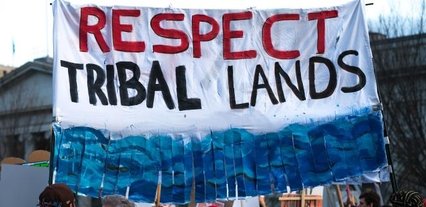
A sign at a protest agains the Dakota Access Pipeline in Washington D.C. on February 8th, 2017 (Credit: Victoria Pickering/Flickr.com)
White Nationalism and the Erasure of Indigenous Identity
Modern white nationalism is deeply tied to eliminating Native sovereignty and identity. Some key overlaps include:
- The “Great Replacement” Theory: White nationalists fear being “replaced” by non-white populations—but Native Americans were the first victims of racial replacement through genocide and forced assimilation.
- “Blood and Soil” Ethnonationalism: White nationalist groups claim the U.S. is a country “built by and for white people,” directly mirroring settler colonial logic.
- The Attack on Multiculturalism: Indigenous sovereignty and cultural autonomy are framed as “special privileges” that should be eliminated under “equal treatment for all.”
- The contemporary idea that America was founded as—and was intended by God to be—a Christian nation. Learn more and Forced Assimilation: The rise of A movement originally identified and named in the 1990s by evangelical theologian C. Peter Wagner. The NAR has since become the leading political and cultural vision of the Pentecostal and Charismatic wing of evangelical Christianity. Learn more (NAR) Christianity aligns with historical forced assimilation policies, seeking to erase Native spirituality, culture, and governance in favor of an authoritarian In the classical definition, a system in which governmental leaders are clergy. Learn more .
Indigenous Communities Under Racist Authoritarian Regimes
Throughout history, Indigenous peoples under authoritarian rule experience:
- Mass displacement and land seizures (Brazil under Bolsonaro, Canada’s residential schools, Russia’s treatment of Siberian Indigenous groups).
- State-sponsored violence (Mexico’s crackdown on Zapatistas, China’s Repression occurs when public or private institutions—such as law enforcement agencies or vigilante groups—use arrest, physical coercion, or violence to subjugate a specific group. Learn more of Uyghurs).
- Criminalization of Indigenous activism (Standing Rock protesters being labeled as terrorists).
- Forced assimilation and cultural genocide (Australia’s Stolen Generations, the U.S. boarding school system).
Bottom Line: Authoritarianism always moves to erase Indigenous rights because Indigenous governance provides an alternative to state control.
Why Fighting for Native Sovereignty is an Anti-Authoritarian Strategy
If you care about resisting authoritarianism, you need to be fighting for Indigenous sovereignty.
- Indigenous Sovereignty is an Alternative to Authoritarianism: Tribal nations function outside of federal control in key ways. Strengthening Native governance weakens centralized authoritarian power.
- Treaty Rights Set a Precedent for Resistance: If treaties are upheld, it proves that governments can be held accountable. If treaty rights are erased, all civil rights are at risk.
- Native Communities are Already on the Front Lines: From Standing Rock to Land Back, Indigenous activists are already resisting corporate and state authoritarianism.
- We Can Learn From Indigenous Resistance: Native nations have been fighting settler colonial authoritarianism for centuries—they’ve built strategies that modern anti-authoritarian movements can learn from.
- Self-Interest: Authoritarianism Doesn’t Stop at Indigenous Communities: Policies first used against Native peoples—land seizures, forced displacement, militarized policing—are later used against other marginalized and dissenting groups. Stopping Indigenous The use of violence, intimidation, surveillance, and discrimination, particularly by the state and/or its civilian allies, to control populations or particular sections of a population. Learn more slows authoritarian expansion.
“White The belief in the primacy of “the nation” as the most important political allegiance, that every nation should have its own state, and that it is the primary responsibility of the state and its leaders to preserve the nation. Learn more and authoritarianism aren’t just political movements—they’re direct extensions of settler colonialism.”
What Can We Do?
- Defend Treaty Rights and Tribal Sovereignty: Support legal efforts to uphold tribal jurisdiction.
- Call Out White Nationalist Attacks on Native Identity: Expose the narratives that attack Native sovereignty.
- Support Indigenous-Led Resistance Movements: Back campaigns like Land Back, Standing Rock, and Native environmental protections.
- Challenge Christian Nationalist Influence: Expose and counter Christian nationalist groups targeting Native communities.
- Build Multi-Racial Alliances: Connect Native resistance movements with broader anti-authoritarian efforts.
Conclusion
White nationalism and authoritarianism aren’t just political movements—they’re direct extensions of settler colonialism. If we don’t understand how the U.S.’s history of Native genocide, tribal termination, and treaty violations set the stage for modern authoritarianism, we’ll never defeat it. Indigenous sovereignty is one of the strongest challenges to authoritarian rule—so if you’re serious about resisting, you need to stand in solidarity with Native nations.
If you enjoyed this article, consider subscribing to the Anti-Authoritarian Playbook today.