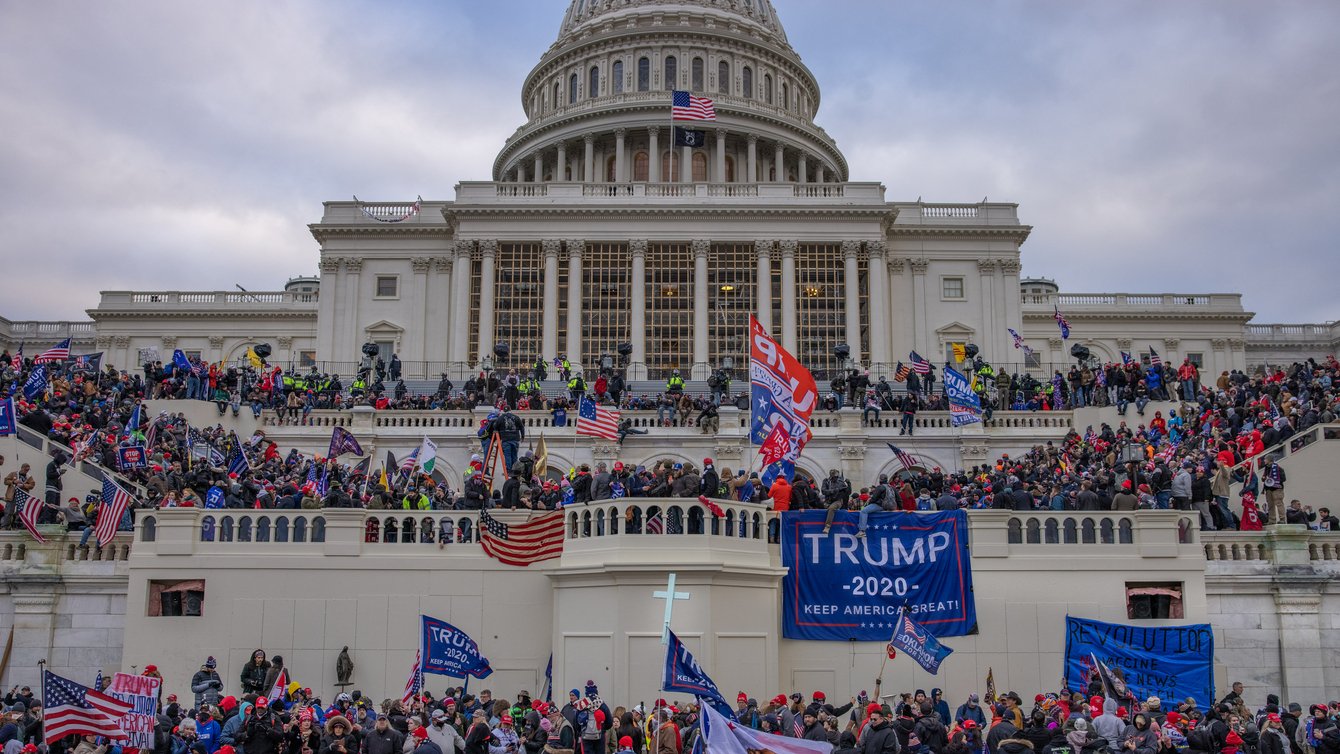
Supporters of President Trump storm the United States Capitol building in Washington, DC on January 6, 2021. (Photo by Evelyn Hockstein/For The Washington Post via Getty Images)
While “Back the Blue” sentiment reigned supreme in the Short for Make America Great Again, the slogan of Donald Trump’s 2016 presidential campaign. Learn more movement during the summer of 2020’s Black Lives Matter uprising, by January 6, repeated clashes with police at right-wing protests led many Proud Boys, White nationalist “Groypers” and other MAGA supporters to arrive in Washington ready to battle law enforcement. During the insurrection, one police officer was killed by a crowd that, paradoxically, flew “Thin Blue Line” flags as they stormed police barricades.
One insurrectionist flies the Revolutionary War-era “Appeal to Heaven” flag, since adopted as the marker of the eco-fascist “Pine Tree Party” movement. As environmentalism is reintroduced to federal governance under Biden, we will likely see the growth of eco-fascist movements on the Far Right that couch A social movement based on a belief in biologically determined racial hierarchies, often with the ultimate goal of establishing an all-White nation state. Learn more in the language of ecological preservation: that the expulsion of non-White immigrant populations and the eradication of vulnerable communities are necessary to the curbing of environmental degradation.
Betsy DeVos, Trump’s Secretary of Education, was one of a number of cabinet members to resign citing the violent insurrection. DeVos used her term to undermine protections for An umbrella acronym standing for lesbian, gay, bisexual, transgender, and queer or questioning. Learn more students, students of color, and survivors of school-based violence and harassment.
Several members of Congress, and their staff and families, were diagnosed with COVID-19 after retreating to a secured area in the Capitol complex to be safer from the insurrectionists. Many others in the safe room were not wearing masks, and refused to do so when asked. Rep. Ayanna Pressley (D-MA), whose husband has since tested positive, chose to leave the secured area in order to minimize her own risk of contracting the virus.
Why were there so few Capitol Police on January 6, given that the FBI and right-wing researchers around the country knew for months that protesters were planning on storming the Capitol that day? The lack of police presence and ability to oppose the Generically used to describe factions of right-wing politics that are outside of and often critical of traditional conservatism. Learn more protesters demonstrated a sharp racial and ideological disparity, prompting national conversations on what it would have looked like if it was Black Lives Matter demonstration that day instead. The events at the Capitol laid bare law enforcement sympathy for Trump, MAGA protesters, and far-right forces more broadly. Yet narratives continue to call for more police and heightened surveillance as the solution to far-right insurgencies. Rather than look to the Movement for Black Lives for leadership, these narratives make themselves complicit in the very systems that oppress communities of color.
A lot of responses to the insurrection, including that of President Biden, amounted to the declaration: “This isn’t America.” But what really is America? Isn’t America the country that stole land from Native people? The country that fought a war because they couldn’t agree on abolishing slavery? The insurrection is only more evidence that people in power can’t take no for an answer. White men are afraid of losing the power they’ve held since the inception of the United States, and seem willing to do anything to hold on to that power. So isn’t this precisely what “America” is?
Jacob Anthony Chansley, the horn-helmeted “Q Shaman,” is being held for his participation in the insurrection. Chansley’s hunger strike against the unavailability of organic food in custody has been widely mocked, overshadowing important conversations about the weaponization of food access as a form of carceral control, largely wielded against people of color.
The familiar Betsy Ross flag that features a circle of 13 white stars on on a blue canton is one of the more nuanced symbols of Both a system of beliefs that holds that White people are intrinsically superior and a system of institutional arrangements that favors White people as a group. Learn more . Along with the Gadsden “Don’t Tread on Me” flag, it’s been adopted by elements of the Patriot and militia movements since the 1990s. It combines nostalgia for a lost world—when men were men, Indigenous genocide was in, and Black people were enslaved—with a wide-eyed schoolbook enthusiasm for the “spirit of ’76.” Far subtler than the Confederate flag, the Betsy Ross flag speaks to a call to arms in defense of an idealized past—visually amplifying the chants of “1776” by a mass of Proud Boys as they marched today the Capitol building. The 13-star circle is also integral to the logo of the III Percenters, the largest militia group in the contemporary U.S.
Dozens of current and former police officers and military service members were among the mob that stormed the Capitol. Their participation underscores how pervasive right-wing ideology is among law enforcement and state forces. Removing these individuals from their positions is needed, but must occur alongside systemic changes to address inequities.
The mob that stormed the Capitol was at least partly incited and unleashed by A movement that emerged in the 1970s encompassing a wide swath of conservative Catholicism and Protestant evangelicalism. Learn more leaders who have long sought to delegitimize and ultimately overcome the ideas and institutions of constitutional democracy that still stand in the way of their theocratic objectives. In the days and weeks before the insurrection, leaders of the Christian Right sought to overturn the election, and helped lead the “Jericho Marches” at the U.S. and state capitols that set the stage for the siege. The significance of their choice of biblical metaphor should not go unremarked. In the biblical story of Jericho, God commands the Isrealite army, carrying the Ark of the Covenant (which contained the original Ten Commandments), to invade and conquer the city. When they do, they slaughter everyone in it.
After the insurrection, multiple platforms banned Trump for incitement of violence, and quickly deplatformed other right-wing people and groups as well. Vast amounts of disinformation have been spread via social media for years, feeding An attitude toward social identities that can be mobilized to justify discrimination, state/vigilante violence, and exploitation. Learn more and intolerance. QAnon, many adherents of which participated in the insurrection, relied on YouTube and Facebook to grow the movement’s numbers; Twitter was rife with right-wing messages. Some observers responded that deplatforming is the bare minimum that social media companies can do, even if it’s merely a gesture at this point. Others noted that while governments and private companies have different rights and responsibilities around free speech and platform safety, increased surveillance and policing by either will disproportionately harm Black, Brown, and other people of color, LGBTQ people, sex workers, and political dissidents of all stripes.