
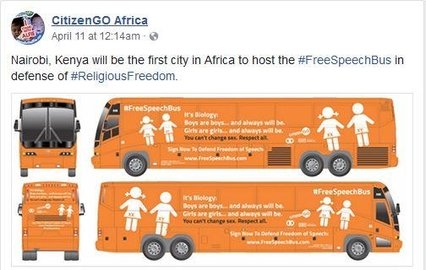
CitizenGO Africa recently announced on Facebook that Nairobi, Kenya would be the first city on the continent to host the so-called #FreeSpeechBus.
CitizenGO Africa recently announced that Nairobi, Kenya would be the first city on the continent to host the so-called #FreeSpeechBus. The bus, infamous for its explicitly anti-transgender messages, will likely roll through Nairobi in conjunction with the World Congress of Families’ regional gathering scheduled to take place on May 15, 2018.
CitizenGO was launched in 2013 as the online petition platform of HazteOir, a right-wing organization based in Madrid, Spain with Catholic roots. The initiative claims to have almost 9 million members, and works to advance an anti-LGBTQ, A movement that emerged in the aftermath of Roe v. Wade, a decision which prevented states from outlawing abortion under most circumstances. Learn more agenda in Europe, the U.S., and increasingly throughout the Global South. In addition to CitizenGO-initiated petitions, a wide range of right-wing organizations use the platform to promote their own causes, including the World Congress of Families and Americans United for Life.
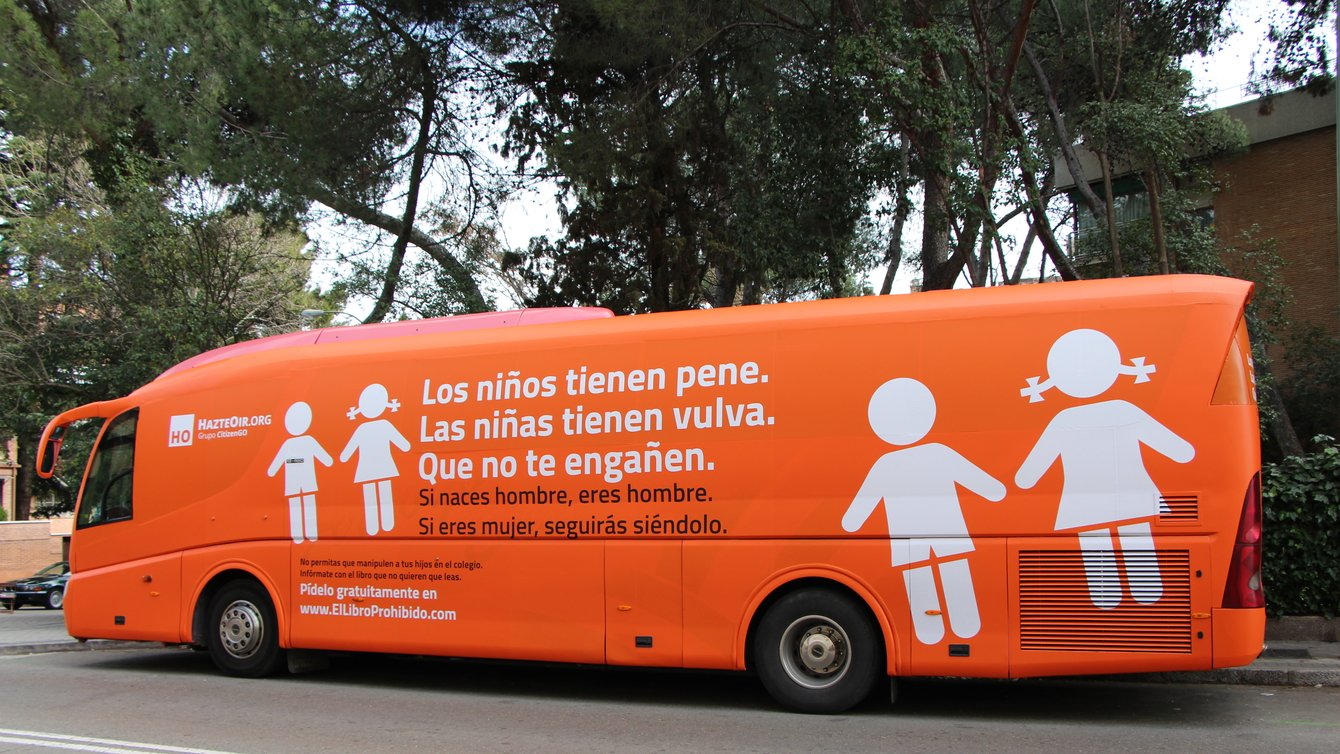
Since its founding in 2013, CitizenGO has gained its greatest notoriety for its anti-trans “Free Speech Bus,” which toured the U.S. in 2017 emblazoned with the slogan “It’s Biology: Boys are boys … and always will be. Girls are girls … and always will be. You can’t change sex. Respect all.” The American version of the bus was preceded by a similarly styled bus in Madrid, which carried the message, “Boys have penises, girls have vaginas. Don’t let them fool you. If you’re born a man, you’re a man. If you’re a woman, you will continue to be so.” The bus has also made appearances in France, Germany, Italy, Mexico, Chile, and Colombia.
Though it’s often portrayed as an isolated element of the A movement that emerged in the 1970s encompassing a wide swath of conservative Catholicism and Protestant evangelicalism. Learn more ’s standard fare anti-LGBTQ agenda, the #FreeSpeechBus is actually part of a much larger, multi-faceted movement against what the Right has dubbed “gender ideology.” As Gillian Kane recently outlined in The Public Eye, “gender ideology is a right-wing invention that intentionally misrepresents feminist, queer, and gender theory in order to justify The act of favoring members of one community/social identity over another, impacting health, prosperity, and political participation. Learn more against women and LGBTQ people.” The term was fabricated by the Vatican in the mid-1990s in an effort to paint gender as a newly invented concept that is dangerous and destabilizing to children, families, and society at large, as well as antithetical to science and reason.
In February 2018, HazteOir and CitizenGO hosted the first International Conference on Gender, Sex and Education, featuring a slate of anti-LGBTQ “experts,” including several representatives from American right-wing groups. Glenn Stanton from Focus on the Family argued that “gender theory” is a lie and the idea of a gender spectrum is false. Rubén Navarro, head of the Geneva office of Alliance Defending Freedom, warned of the encroachment of “gender ideology” into international laws and policies. Miriam Ben-Shalom, an American anti-trans lesbian activist linked A term used for someone whose gender is not (exclusively) the one they were assigned at birth. Learn more activists to pedophilia. Ultimately, the event aimed to advance the idea that “gender ideology” is a conspiracy — the latest plot designed by radical homosexual activists to destroy families, contradict biology, erase Biblical gender roles, and persecute Christians.
The irony is that both sides argue that gender is a socially constructed concept. For progressive feminists, LGBTQ activists, and gender theorists, constructs of gender that strictly prescribe roles for men and women are perceived to have been wrongly imposed on individuals who may possess myriad identities and expressions of gender, apart from one’s sex or sexual characteristics. Sources of these impositions include various patriarchal institutions that are understood to have disrupted naturally occurring gender variance and equanimity through systems of violence and domination.
For the Right, “gender theory” is perceived as a contemporary concept aimed at erasing unique and definitive feminine and masculine characteristics that are exclusively tied to one’s biological sex (and limited to male and female). This framework fails to take into account the existence of intersex people, and denies the gender variance that is most often observed in transgender and genderqueer people, but also manifests in a multitude of diverse expressions of gender among A term that describes someone whose gender identity matches the sex they were assigned at birth. Learn more people as well. Ignoring all this, the Right suggests that the acknowledgement of these realities is an LGBTQ conspiracy designed to destroy families and sexualize children. They call it “gender ideology,” and they’re effectively using it to instigate a sort of moral panic that ultimately distracts societies from real structural issues, such as poverty, disease, government corruption, and growing inequalities.
The effectiveness of this strategy was especially evident in voters’ surprising rejection of Colombia’s landmark peace agreement in 2016. On October 2, 2016, Colombians were summoned to vote in a referendum aimed at terminating the long-standing conflict between the Colombian government and the Revolutionary Armed Forces of Colombia (FARC). The war had spanned more than 50 years, resulting in the deaths of more than 220,000 Colombians and displacing nearly seven million people. But despite strong public support for peace, 50.2 percent voted to oppose the referendum.
Anthropologist Winifred Tate reported that those who opposed the peace agreement circulated pamphlets declaring, “Colombia is in danger! Of falling under the control of a communist dictatorship and the imminent passage of a A conspiracy theory coined by the Vatican in the 90s that misrepresents feminist/queer theory as dangerous to families/society. Learn more .” Many credit the success of the “no” campaign with their effective mobilization of A form of heterosexism that devalues and scapegoats gay, lesbian, and bisexual people and people in same-gender relationships. Learn more and fear of expanded LGBTQ rights by linking their cause to a national debate over new, more progressive gender and sexuality education materials for high schools produced by Colombia’s Ministry of Education.
To the Right, the “gender ideology” menace is rapidly expanding its reach globally, and the CitizenGO bus has become something of a big orange mascot for the movement. But it doesn’t roll without resistance.
In Madrid, a judge banned the bus from traveling through the city on the grounds that it was discriminatory and could provoke hate crimes. In the U.S., counter protestors greeted the bus’s arrival on every stop of its attempted tour. In Bogota, the LGBTQ activists splashed multicolored paint on the vehicle.
Kanyali Mwikya, a program advisor at the Kenya Human Rights Commission, responded to the news of the pending visit of the bus to Nairobi, warning CitizenGO, “Human rights defenders shall not sit quietly as you bring this hate speech bus to Nairobi. Like in every part of the world where this bus of hate has visited, get ready for counter action against you [sic] campaign of disinformation and evil!”
Whether the bus is ultimately stymied or not, though, the Right’s anti-“gender ideology” strategy is already taking hold and will likely continue to develop as one of the key sources of right-wing resistance to gender, sexual, and reproductive rights globally.